
Rasa Multilingual AI
Build AI agents that scale across languages and markets.
Quick facts
- Best for
- Chatbots
- Pricing
- Freemium
- Editor rating
- 4.5 / 5
- Community saves
- 0
About Rasa Multilingual AI
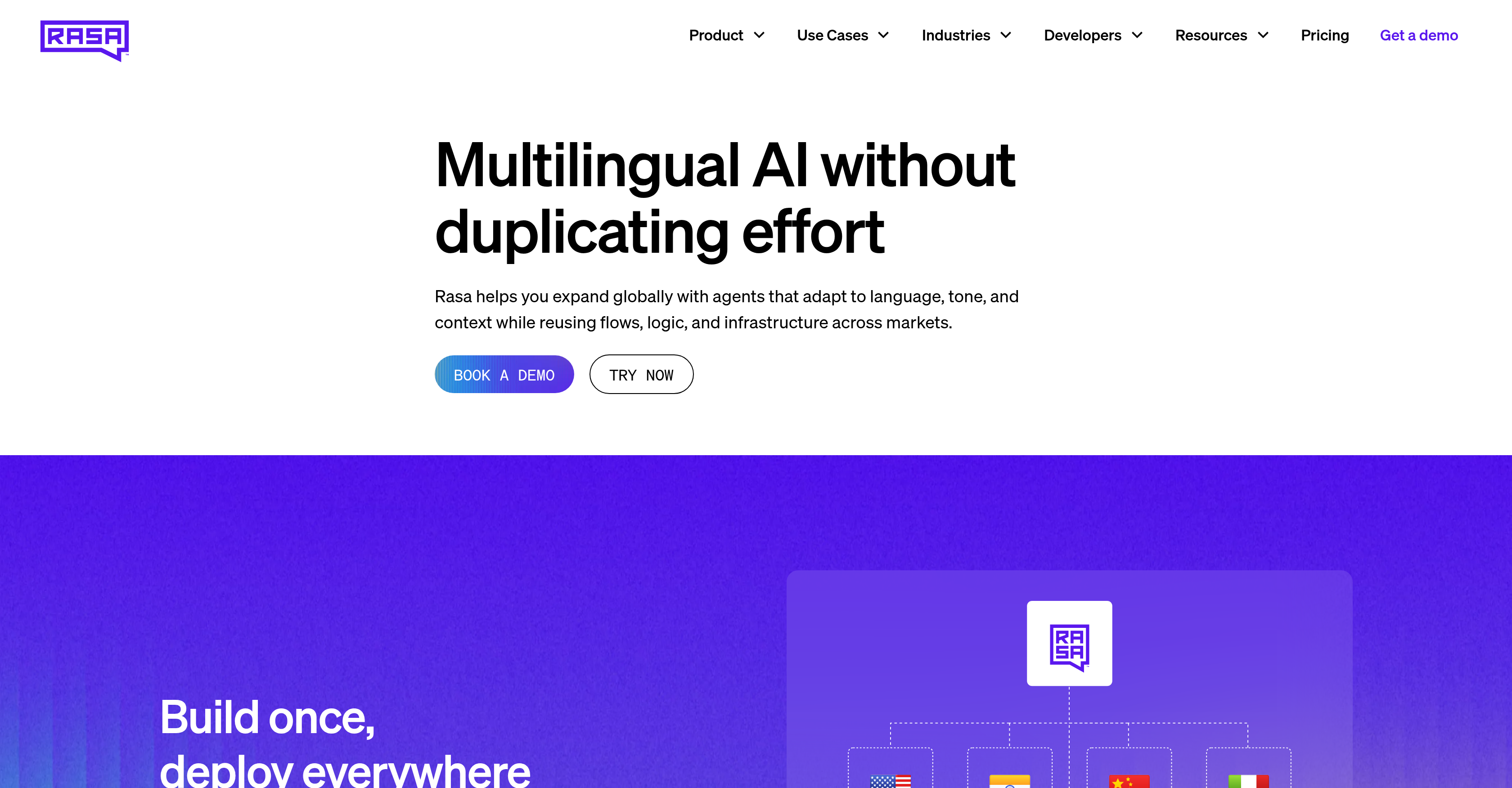
Generated by ChatGPT Rasa Multilingual AI is a tool designed for the construction of AI agents that are capable of scaling across international markets and languages. The platform allows the reuse of established flows and logic, with the flexibility to adjust to language-specific tone, context, and phrasing. Rasa also includes features such as structured flows, deterministic logic, built-in recovery patterns, and more, designed to extend large language models (LLMs). A significant function of Rasa is its real-time information retrieval feature, aligning every answer with verifiable and trusted data. The platform also offers the capability to conduct multilayered, adaptable conversations, incorporating memory and logic. Aiming to foster operational efficiency, it helps in automating processes, delegating more elaborate tasks to the support team. It's useful for different industries like finance, retail, government, insurance, healthcare, telecom, travel, and hospitality. Companies can take advantage of the Multilingual AI feature to expand globally, allowing AI agents to shift languages, maintain context, and consistently manage brand messaging. It aids in reusing dialog structures across various regions and languages without rebuilding the core functionality, and supports multiple languages using shared flows and logic. Additionally, to assist developers, Rasa provides substantial documentation, an education center, and resources like webinars, whitepapers, case studies, etc.
Pros
- Structured flows
- Deterministic logic
- Built-in recovery patterns
- Real-time info retrieval
- Adaptable conversations
- Fosters operational efficiency
- Aids task delegation
- Applications in multiple industries
- Facilitates Global Expansion
- Maintains Brand Messaging
- Reuses dialog structures
- Supports multiple languages
Cons
- No direct API integration
- Limited to text-based conversations
- No voice support feature
- Not suitable for small businesses
- High-degree of complexity
- No out-of-box solution
- Limited customization options
- Slow implementation process
- Learning curve for new developers
- No real-time updates