
Quick facts
- Best for
- LLM training
- Pricing
- Freemium
- Editor rating
- 4.5 / 5
- Community saves
- 0
About Perpetual ML
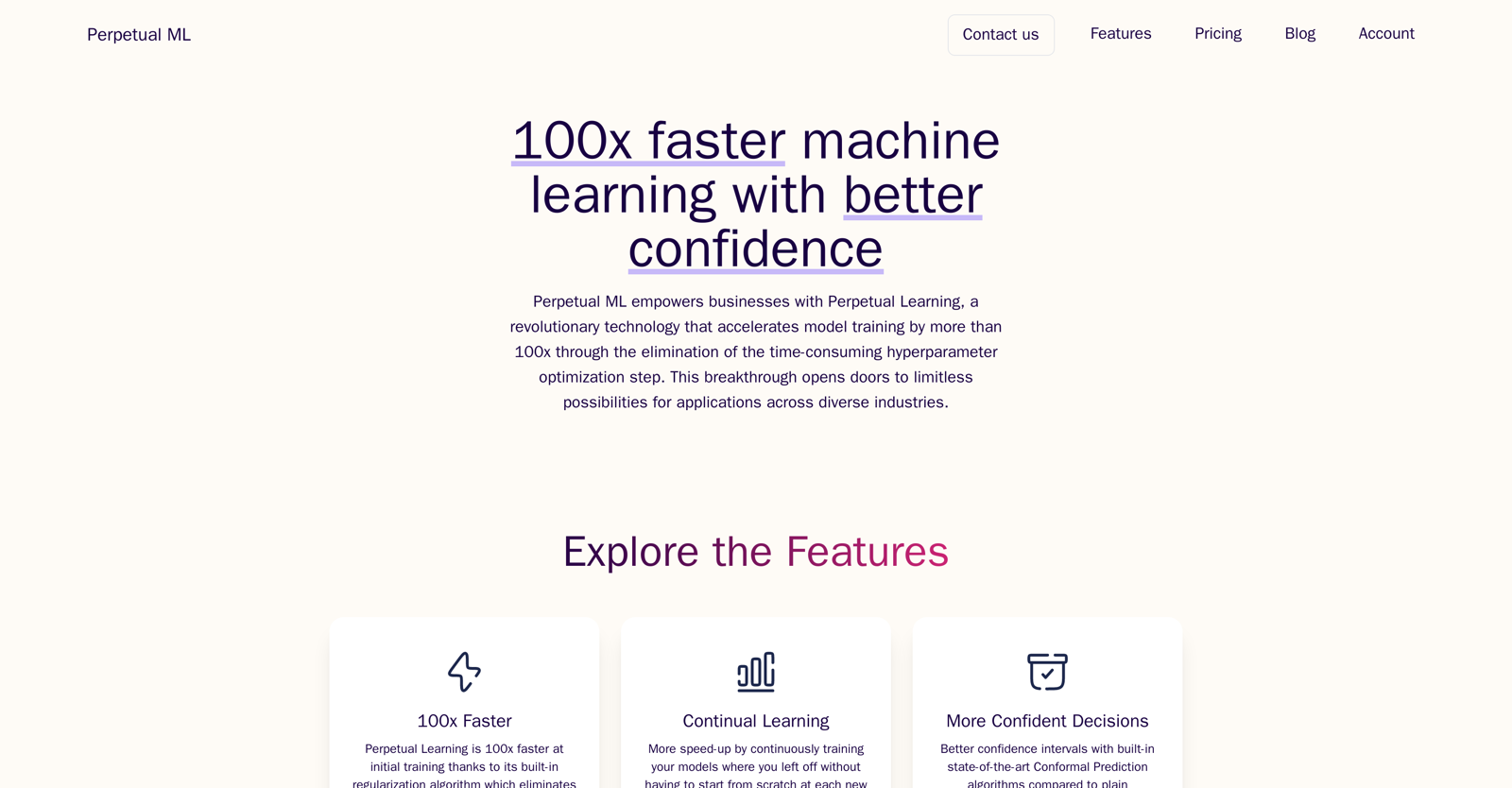
Perpetual ML is an AI tool that leverages a unique technology, known as Perpetual Learning, to drastically accelerate model training. This acceleration is chiefly achieved by removing the time-consuming hyperparameter optimization step, thus providing substantial speed-ups. It offers a range of capabilities including initial fast training via a built-in regularization algorithm, the convenience of continual learning enabling models to be trained incrementally without starting from scratch with each new batch of data, and enhanced decision confidence through built-in Conformal Prediction algorithms. Additionally, it provides methods for improved learning of geographical decision boundaries and has a feature to monitor models and detect distribution shifts. The platform is suitable for various machine learning tasks such as tabular classification, regression, time-series, learning to rank tasks and text classification, among others. It offers portability across various programming languages, including Python, C, C++, R, Java, Scala, Swift, and Julia, owing to its Rust backend. Designed with a focus on computational efficiency, Perpetual ML doesn't require specialized hardware for its operations.
Pros
- Accelerates model training
- Removes hyperparameter optimization
- Initial fast training
- Offers continual learning
- Enhanced decision confidence
- Conformal Prediction algorithms
- Geographical Decision Boundary Learning
- Detects distribution shifts
- Supports multiple ML tasks
- Supports various programming languages
- No specialized hardware required
- Compatible with Python
Cons
- No hardware specialization
- No hyperparameter optimization
- Requires continual retraining
- Dependent on Rust backend
- May oversimplify model complexity
- Limited model monitoring
- Geographical learning biases
- Unspecified regularization methods
- Unspecified confidence measurement
- Only suitable specific tasks