
Quick facts
- Best for
- Apps
- Pricing
- Freemium
- Editor rating
- 4.5 / 5
- Community saves
- 0
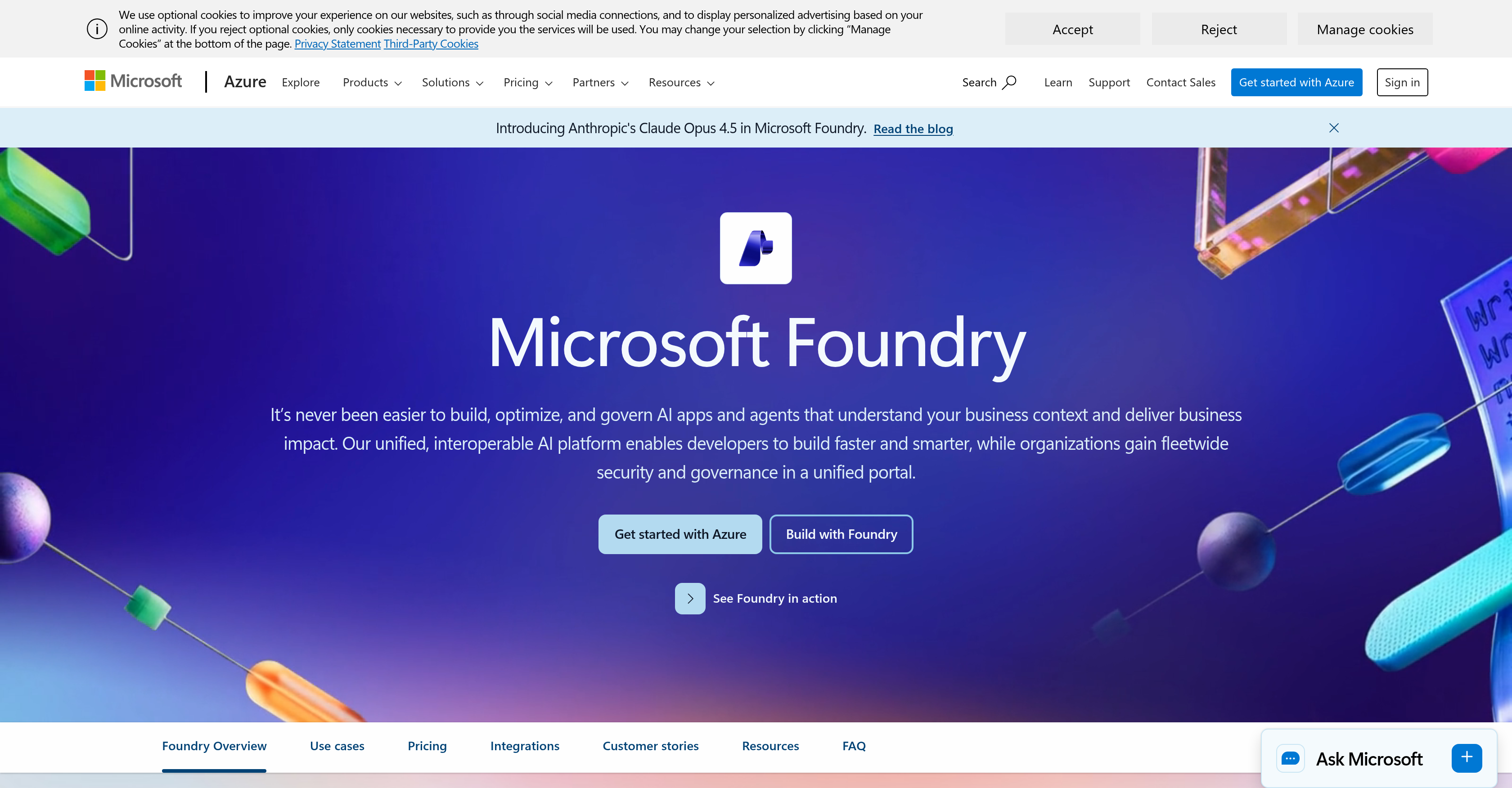
About Microsoft Foundry
Microsoft Foundry is a comprehensive, integrated, and interoperable AI platform, acting as a factory for AI apps and agents. Part of Microsoft Azure, it is designed to deeply accelerate AI-driven, cloud-native development for numerous industries. The platform allows developers to build intelligently and efficiently, enabling the creation of AI apps and agents that understand business contexts and can deliver substantial business impact. Essentially, it is a centralized AI hub offering a unified interface and ability to optimize and manage AI development initiatives. The platform provides fleetwide security measures and governance in a unified portal, which simplifies AI management and safeguards data and workflows. Microsoft Foundry also hosts a wide selection of models, which can include foundational, open, reasoning, multimodal, and industry-specific models, allowing developers to benchmark and compare models for each application. Moreover, it is empowered with various Azure services like Azure AI Search, Azure OpenAI, Azure Content Understanding, Azure Speech, and Azure Machine Learning. As such, Microsoft Foundry provides an end-to-end solution, from model selection to application deployment and management, all in a secure and governed environment.
Pros
- Interoperable with Azure
- Fleetwide security measures
- Data and workflow protection
- Wide selection of models
- Model benchmarking and comparison
- Enabled with Azure services
- Hosts foundational, open, reasoning, multimodal, industry-specific models
- Optimal business impact potential
- Azure Content Understanding integration
- Azure Speech integration
- Azure Machine Learning integration
- Cloud-native development support
Cons
- Limited to Microsoft Azure
- Could be complex for beginners
- Potentially expensive
- Inefficient for small scale projects
- Dependent on Microsoft ecosystem
- Limited pre-built models
- Minimal customizability
- Overhead for managing services/features
- Closed source