
Quick facts
- Best for
- Contract reviews
- Pricing
- Freemium
- Editor rating
- 4.5 / 5
- Community saves
- 0
About Legly
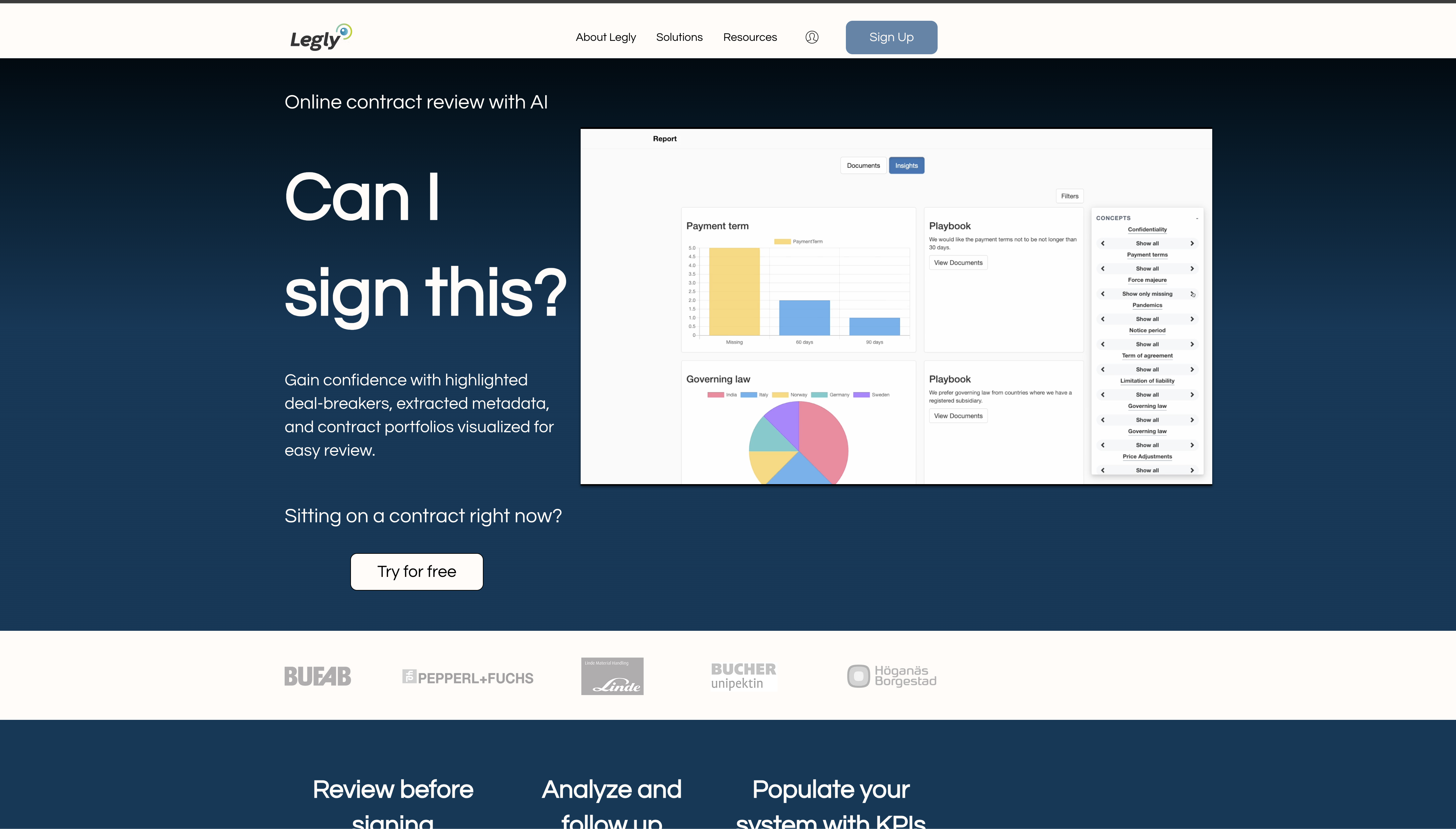
Legly is an AI-powered tool designed to facilitate online contract review. It offers services such as identifying deal-breakers, missing clauses based on your defined preferences, and extracting and visualizing metadata for a better overview of your contracts. Legly assists in populating your Contract Lifecycle Management (CLM), Customer Relationship Management (CRM), Supplier Relationship Management (SRM), and other repository systems with key performance indicators critical for business operations.This tool provides an intuitive and smart search functionality for easier navigation and retrieval of contract-related details. Furthermore, it has the capability to deliver comprehensive red-flag reports, enabling users to get insights about potential risks before signing contracts.Legly supports different types of users including legal technology and service providers, law firms, enterprises, and businesses. It offers seamless integration and allows users to review, analyze, and organize contracts via an online dashboard. Metadata extraction and storage features are available for reduced risk and enhanced efficiency in contract management.Moreover, Legly provides an API, allowing users to integrate this AI contract review system into their existing workflows and systems. Understanding the importance of continuous learning, the platform offers webinars and numerous resources to further understand the use and benefits of AI in contract review processes.
Pros
- Identifies deal-breakers
- Detects missing clauses
- Visualizes metadata
- Populates CLM, CRM, SRMIntuitive search functionality
- Delivers red-flag reports
- Supports diverse user types
- Seamless integration
- Online contract organization
- Reduced risk contract management
- API integration
- Offers webinars
- Comprehensive resource library
Cons
- Limited contract types supported
- May miss nuanced legal interpretations
- Dependence on dashboard interface
- Too complex for smaller businesses
- Limited integration options
- Limited language support
- Generic risk indicator approach
- Over-reliance on user-defined preferences
- No offline functionality
- Potential for false positives/negatives