
Quick facts
- Best for
- Accounting
- Pricing
- Freemium
- Editor rating
- 4.5 / 5
- Community saves
- 0
About Ledger IQ
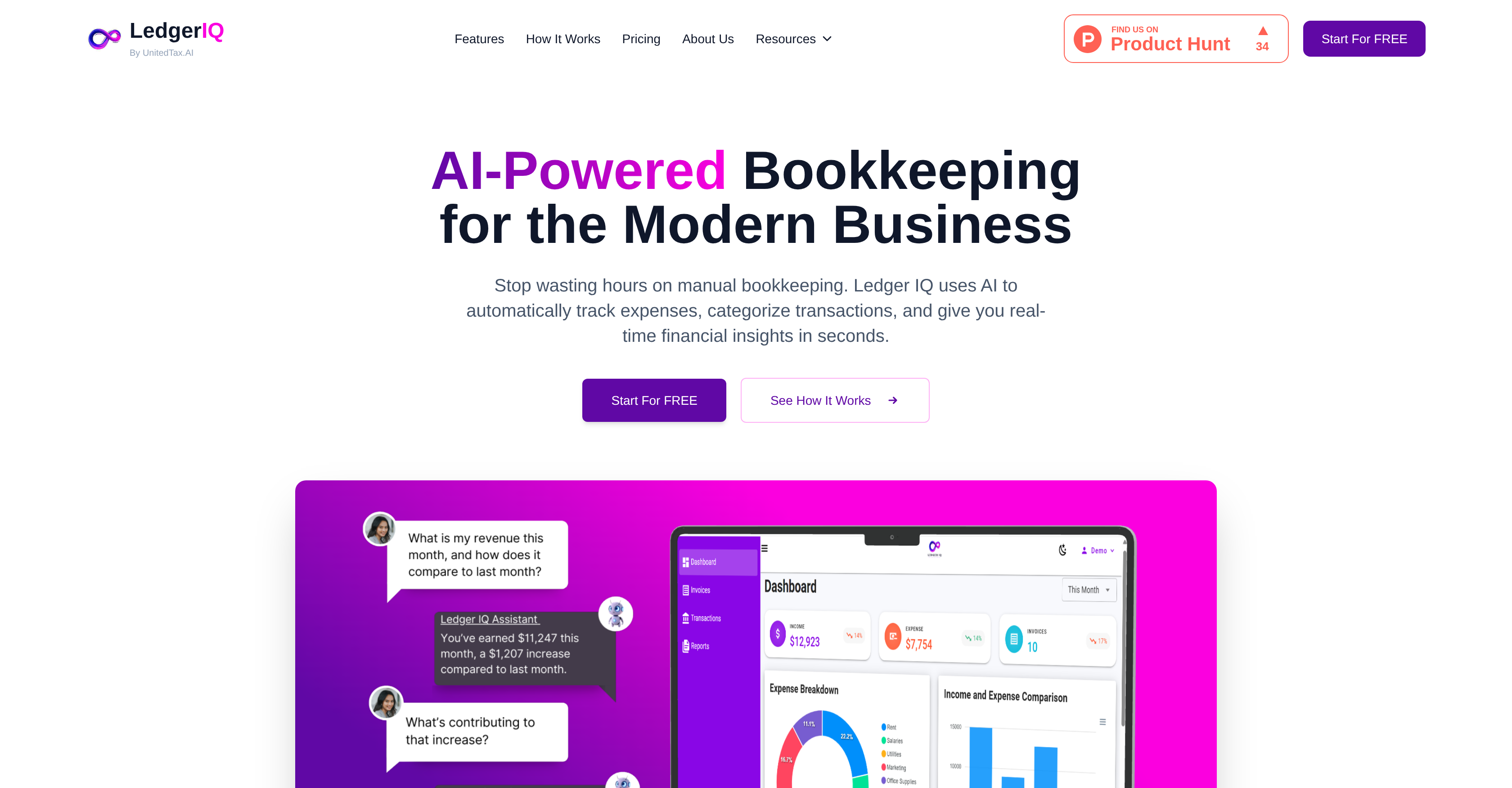
Ledger IQ is an artificial intelligence-powered bookkeeping tool tailored for the modern business environment. Embodying a practical blend of technology and accounting expertise, Ledger IQ seeks to facilitate and streamline finance management processes, automating various tasks that traditionally require the attention of a human bookkeeper. It is designed to handle a range of operations that include but are not limited to invoice processing, expense tracking, and financial record organization. Driven by artificial intelligence, Ledger IQ is capable of providing data-driven insights, helping businesses make informed decisions backed by detailed financial data. It offers a user-friendly interface that aims to make bookkeeping more accessible and less time-consuming, enabling businesses to focus more on their core operations. The AI technology embedded in Ledger IQ enables it to learn and adapt to a company's specific bookkeeping needs over time, increasing its operational efficiency as a result. While this tool empowers businesses to automate their bookkeeping, it also maintains a high level of accuracy and compliance with various accounting regulations. Overall, Ledger IQ is a comprehensive, smart tool for businesses looking to optimize their bookkeeping processes leveraging AI capabilities. Supported featuresFinance & Accounting
Pros
- Adapts to specific bookkeeping needs
- Handles financial record organization
- Automates invoice processing
- Tracks expenses
- Generates data-driven insights
- User-friendly interface
- Streamlines finance management
- Handles payables and receivables
- Manages payroll
- Accurate financial reporting
- Eliminates calculation errors
- Predicts financial trends
Cons
- Requires extensive setup
- Potential misunderstanding of regulations
- Overly complex user interface
- Limited customization
- Too automated, loss of control
- Might miss subtle transaction details
- Limited offline functionality
- High dependency on dataset quality
- Lack of integration with other software
- Inadequate customer support