
Quick facts
- Best for
- AI security
- Pricing
- Freemium
- Editor rating
- 4.5 / 5
- Community saves
- 0
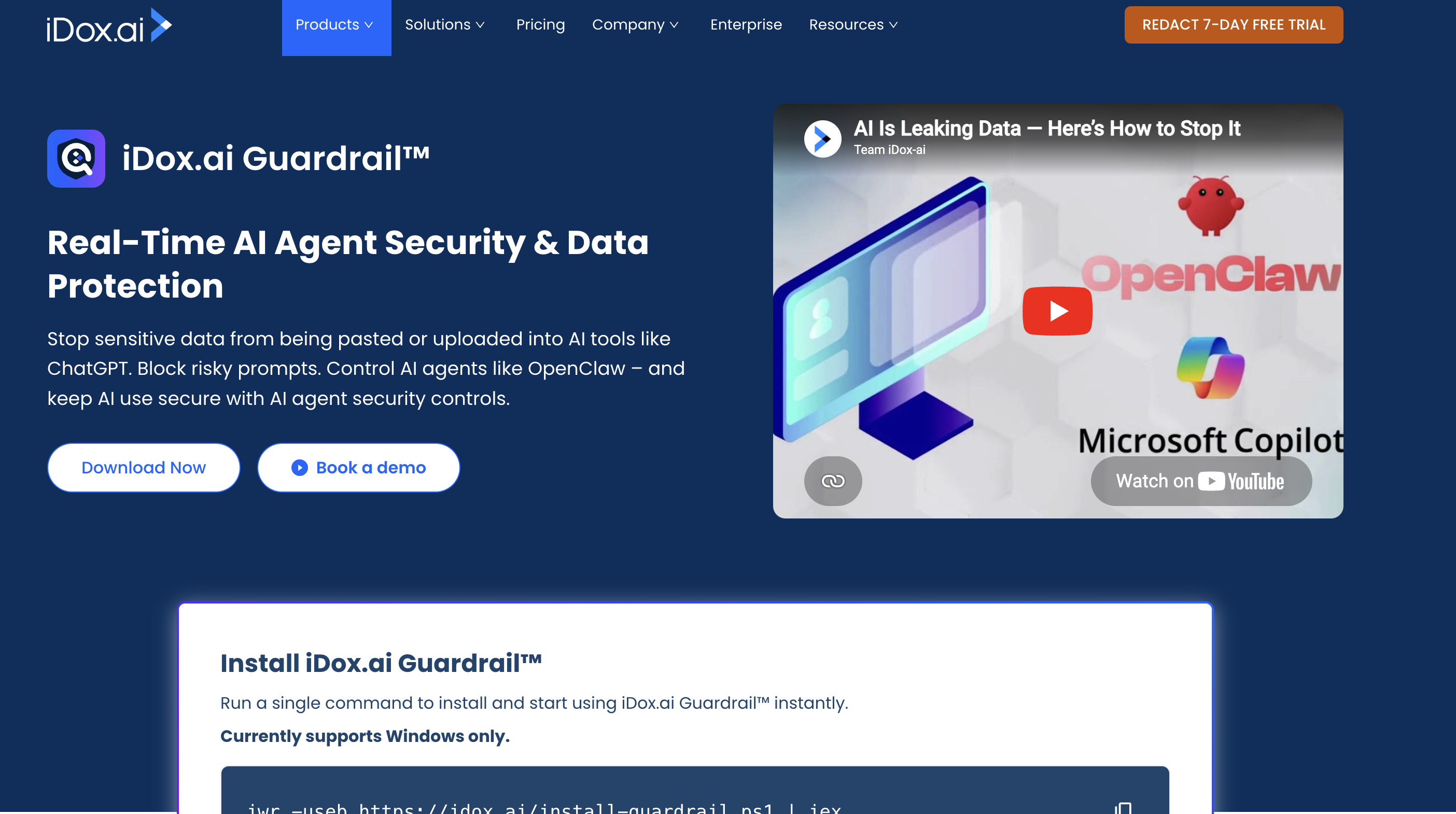
About iDox.ai Guardrail
iDox.ai Guardrail is a real-time AI security software that provides protection from potential data leaks associated with AI tools and agents. Its primary function is to monitor, intercept, and modify or block potentially harmful activities involving sensitive data. This includes prevention of data leaks prior to the involvement of AI tools like ChatGPT, detection of risky prompts or unauthorized instructions, and controlling AI agents such as OpenClaw through allow or deny prompts.This software operates on the endpoint (user device) and processes and enforces policies locally, thus reducing exposure risks and providing a stronger local privacy plus compliance control. It works across a wide spectrum of AI tools including chat-based AI tools, AI copilots and assistants, AI agents and automation tools, and browser-based AI tools.The software provides features for both individual users and enterprise environments. For individuals, it monitors and audits data flow between AI agents to detect and block unauthorized actions. For enterprises, it allows unified policy enforcement, maintains audit records, and supports flexible deployment options suitable to stringent compliance needs.As it operates in real time, it offers instant performance with the use of efficient AI models and works without causing noticeable delays in AI workflows. This software is compatible with Windows now with support for macOS and mobile devices coming soon. Supported featuresCybersecurity
Pros
- Endpoint data processing
- For individuals and enterprises
- Unified policy enforcement capability
- Audit records maintenance
- Supports flexible deployment options
- Instant performance
- Windows compatible
- Future mac
- OS, mobile compatibility
- Blocks unauthorized actions
- Early detection of risky prompts
- Supports automation tools
Cons
- No Mac
- OS or mobile support
- Potential compatibility issues
- Potential false positives
- Installation requires technical knowledge
- Policy enforcement may obstruct workflows
- Depends on local device performance
- Local policy enforcement ambiguity
- No real-time analytics provided
- Proactive blocking may limit functionality