GAAbstract
VerifiedCreate publication-ready graphical abstracts with AI in seconds.
Quick facts
- Best for
- Graphical abstracts
- Pricing
- Freemium
- Editor rating
- 5 / 5
- Community saves
- 0
About GAAbstract
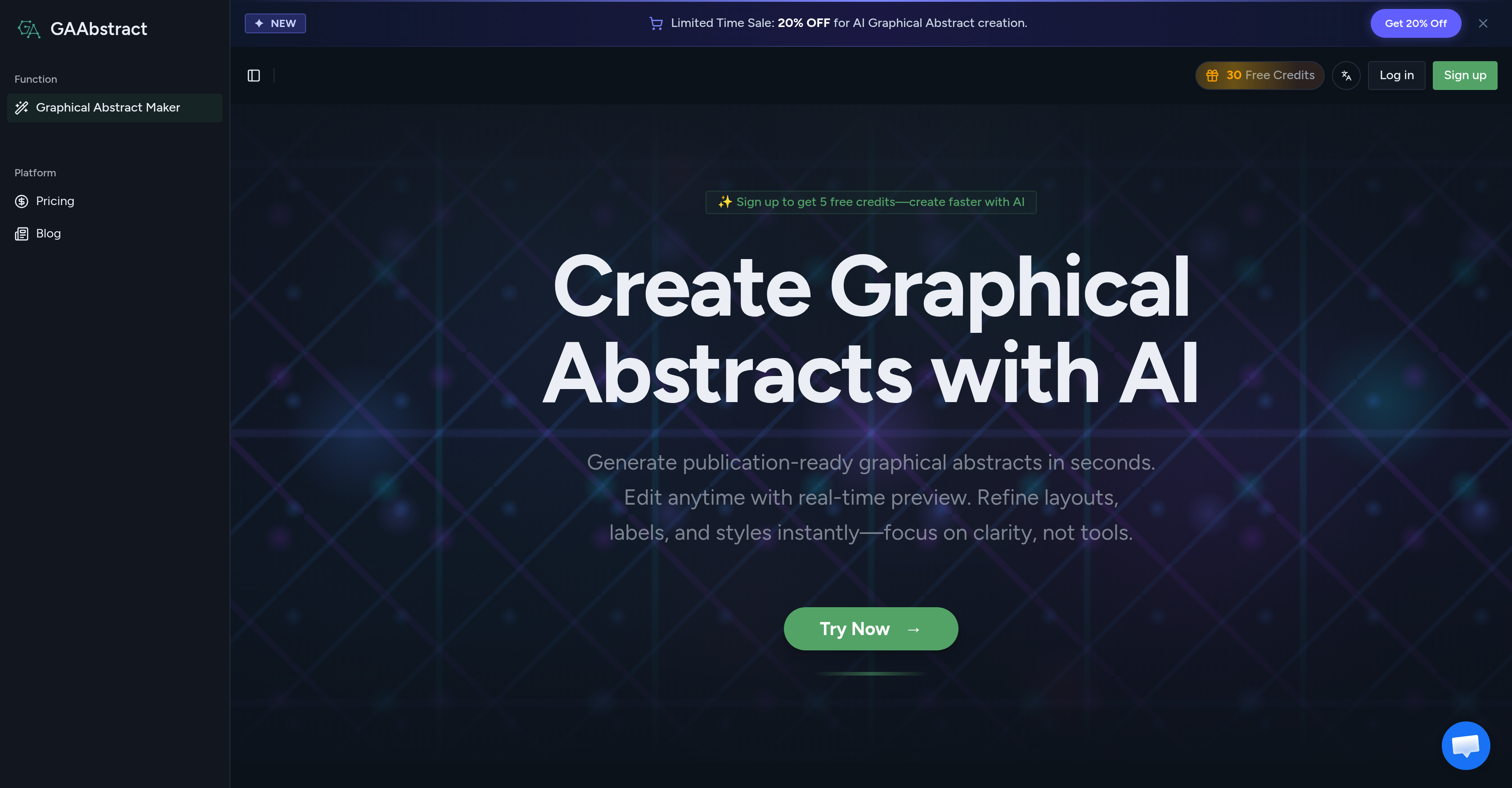
GAAbstract is an AI graphical abstract maker designed for researchers, labs, and academic teams who need clear, professional visual summaries without spending hours in design tools. How it works: Paste your abstract or upload your PDF — the AI analyzes the content, identifies key entities, steps, and relationships, and generates a structured graphical abstract in seconds. Review the result, edit text, labels, layout, and styling as needed, then export in publication-ready formats (PNG, TIFF) at 300 DPI. Key features: AI Understanding — Automatically extracts the core message, methods, and results from your paper to build a clear scientific schematic Seconds to First Draft — Go from a blank canvas to a solid visual in seconds, then iterate instead of redesigning from scratch Fully Editable — Adjust text, labels, icons, layout, and colors anytime to keep the science accurate and the visuals on brand Journal-Ready Specs — Built-in presets for Nature, Science, Cell, JACS, ACS Nano, Advanced Materials, and more — output matches exact DPI and dimension requirements Consistent Lab Style — Reuse colors, typography, and icon styles across papers so every graphical abstract from your team looks cohesive Multiple Export Formats — Download as PNG, JPG, or TIFF at 300 DPI, ready for journal submission, slide decks, or social media Who it's for: PhD candidates and postdocs creating graphical abstracts for journal submissions Lab managers standardizing visual output across multiple papers and collaborators Science communicators sharing research findings on social media Conference presenters building visual summaries for posters and talks Pricing: Free to start with 5 credits. Paid plans available for more credits, higher quality generation, and team workflows. Daily check-in earns free credits. Supported languages: English, Spanish, French, Japanese, Chinese (Simplified & Traditional), German, Korean, Portuguese, Russian.
Pros
- Converts text to graphics
- Simple user interface
- Fast graphical generation
- Edit option for drafts
- Multi-export formats
- Clarity in visualization
- Consistent visual language
- Variation and option comparison
- Efficient workflow support
- Platform sharing capability
- Slide deck creation
- Social media application
Cons
- Limited to researchers
- Might oversimplify complex research
- Charged per graphical abstract
- Complex structure might confuse
- Limited style customization
- Editing requires user intervention
- Lacks multi-language support
- Export format constraints
- Not suitable for non-academic contexts