
Quick facts
- Best for
- Agent management
- Pricing
- Freemium
- Editor rating
- 5 / 5
- Community saves
- 0
About Future AGI
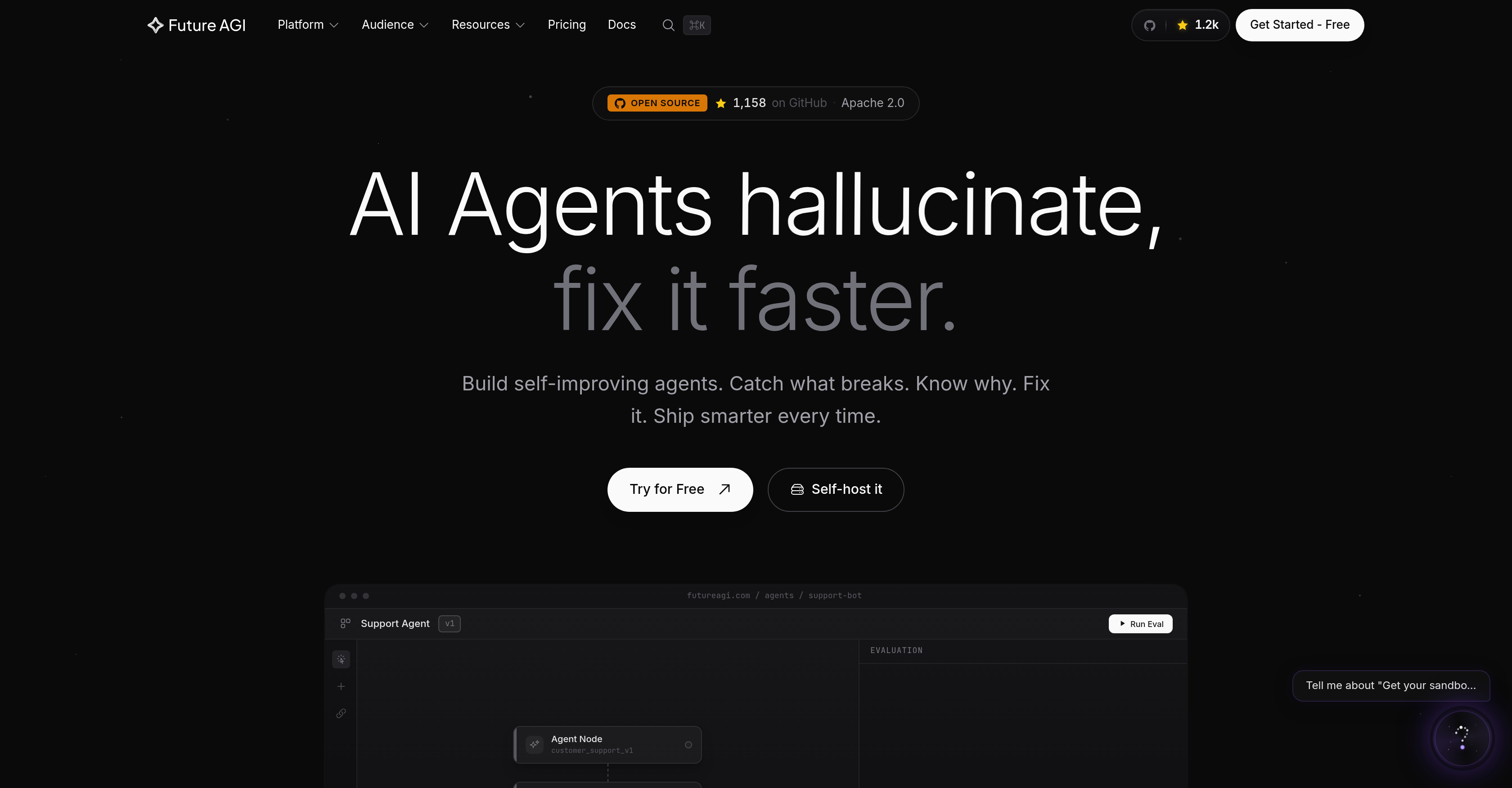
Future AGI is a platform designed to build AI agents and improve them over time. The primary goal of the platform is to create 'self-improving agents' intelligent systems that learn and evolve to better fulfill their assigned tasks. The software is ideal for startups and enterprise-scale businesses, providing user-friendly tools to build, test, refine, evaluate, optimize, and monitor AI applications.The platform's capabilities are segmented into five modules. 'Simulations' lets users generate and test various scenarios and synthetic data at scale. 'Agents' allows iteration and refinement of AI models using various datasets. In the 'Evaluate' module, users can catch issues in their pop simulations, allowing users to anticipate and address errors that could occur in production. When it comes to optimization, the platform employs 'AI Optimization', which aids in improving AI agent performance using collected data. Lastly, the 'Monitor' feature allows users to review how their AI is performing in real-time through dashboards, tracing, alerting systems, and a command center. Moreover, the platform has resources for learning and development, ranging from use cases, blogs, eBooks, and various documentation for developers including API and SDK references as well as integration guides. It also includes evaluation tools like the LLM Cost Calculator and Evaluation TCO Calculator.
Pros
- Offer real-time monitoring
- Simulation for testing
- Synthetic data generation
- Identify issues in real-time
- Platform supports iterative refinement
- Detailed API and SDK references
- Extensive integration guides
- Comprehensive learning resources
- Alert system to prevent breakdowns
- Datasets Agent IDE Experiments framework
- Universal to enterprise and startups
- Agent evaluation tools provided
Cons
- Complex scenario setup
- Limited error tracking
- Unclear evaluation criteria
- Fixed feature modules
- Inadequate multilingual support
- Lack of customization options
- No explicit pricing details
- Cumbersome call data analysis
- Complex system metrics
- Confusing trace ID management