
Document Transcribe
VerifiedTurn handwritten history into searchable digital text.
Quick facts
- Best for
- Document management
- Pricing
- Freemium
- Editor rating
- 5 / 5
- Community saves
- 0
About Document Transcribe
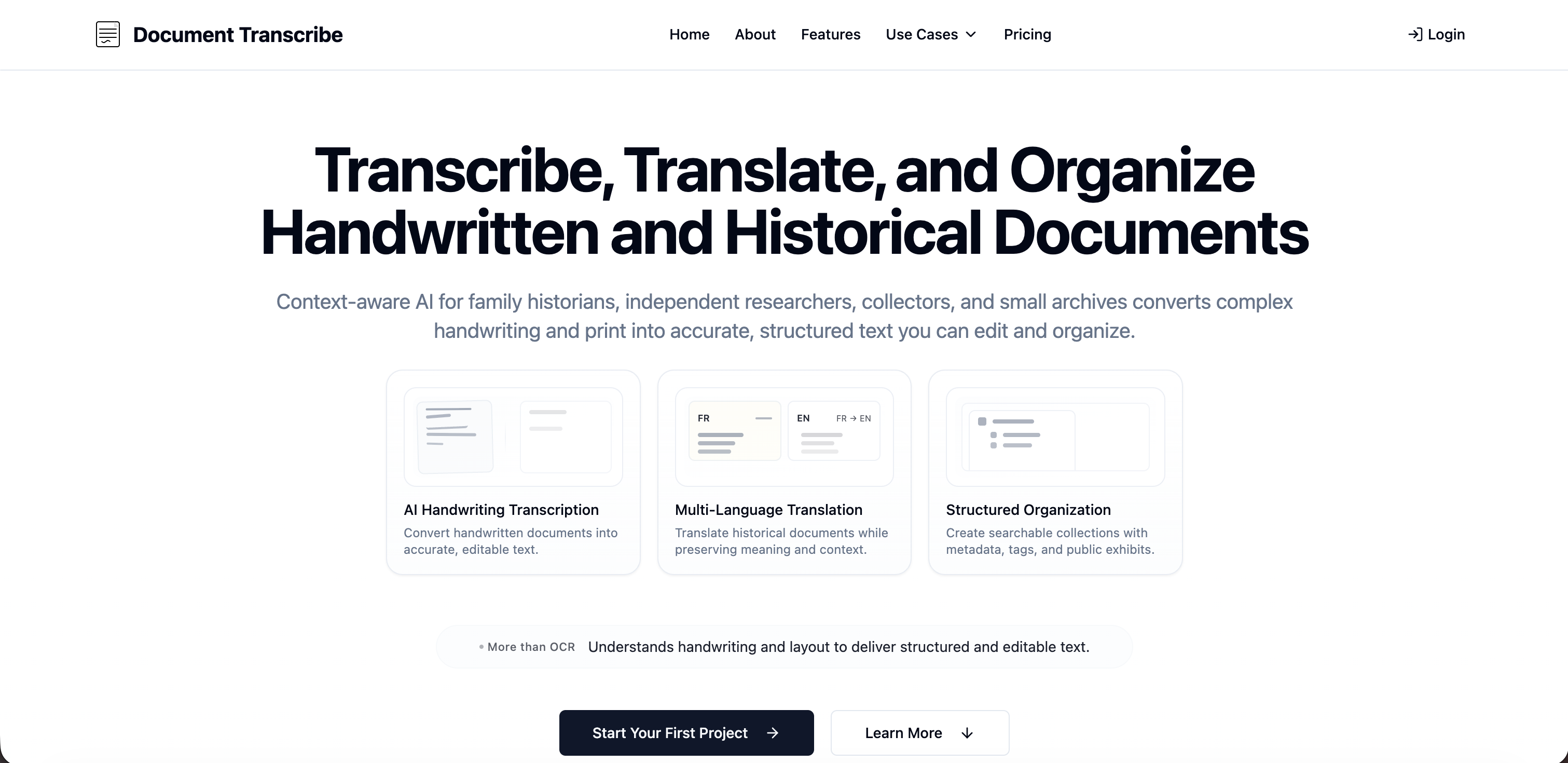
Socials: Document Transcribe is an AI-powered tool primarily designed for family historians, independent researchers, collectors, and small archives. The software has the ability to transform handwritten manuscripts, historical records, and foreign language documents into organized, searchable, and editable digital collections. It leverages context-aware AI technology to convert complex handwriting and print into accurate and structured text. Additional features include multi-language translation and preservation of the meaning and context of historical documents. It also creates searchable collections with metadata, tags, public exhibits and understands the document layout to deliver structured, editable text. Moreover, users can add metadata, tags, and contextual information automatically. The platform is designed to adapt to various types of historical work including family history, research projects, private collections, and small archives. Its structured and searchable outputs make it a valuable tool in the transition of historical artifacts into digital archives. Supported featuresTranscription Key FeaturesHandwritten Document OcrHistorical Document TranscriptionGenealogy Records SupportArchive Project OrganizationSecure Document Sharing
Pros
- Adapts to various historical work
- Preserves context of documents
- Understands document layout
- Generates metadata
- Handwriting to editable text
- Print to editable text
- Multi-language translation
- Organized, searchable collections
- Can add contextual information
- Secure sharing of transcriptions
- Turns foreign language documents into searchable data
- Batch processing for multi-page records
Cons
- Limited to historical documents
- Possible errors in transcription
- Translation may lose nuances
- Charges for transcription, translation
- Does not support video/audio
- Limited project organization options
- Might require manual data correction
- Lacks real-time collaboration features
- Doesn't support bulk metadata edits
- Limited exhibit creation tools