
Quick facts
- Best for
- Apps
- Pricing
- Freemium
- Editor rating
- 4.5 / 5
- Community saves
- 0
About Bind
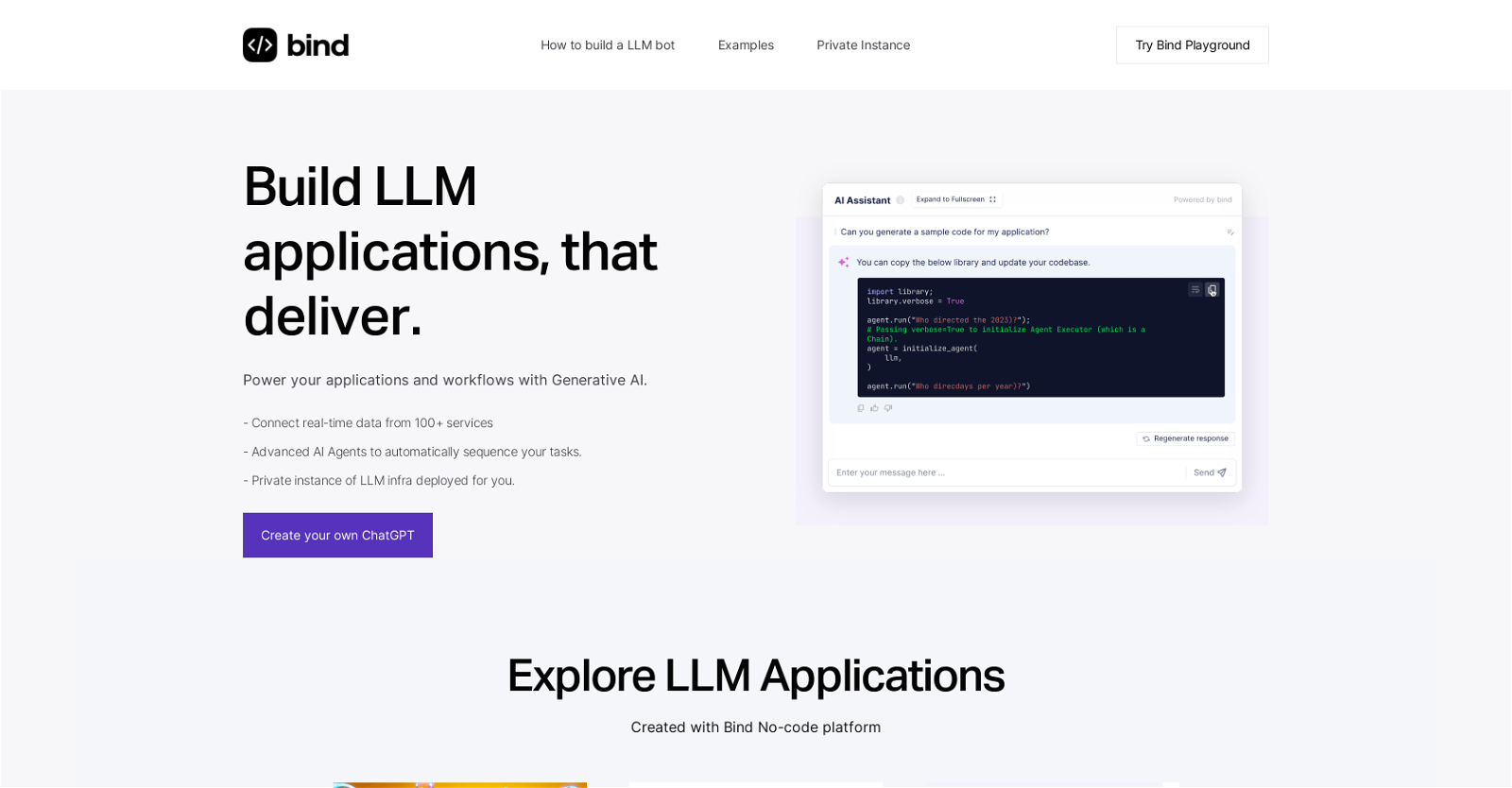
Bind is a collaborative platform designed for the development of Generative AI applications. Primarily, it aids developers in the creation and deployment of Language Model (LLM) applications in a quick and effective manner. With a comprehensive set of tools at its disposal, Bind integrates real-time data from a wide range of services and leverages Advanced AI Agents to effectually streamline tasks. It provides a dedicated environment, the 'LLM Playground', for real-time testing and optimization of LLM responses. Bind also allows users to create a private instance of LLM infrastructure for custom use. The tool promotes the construction of intricate LLM applications with a strong focus on user-specific data and services. Further, it supports the creation of AI-native experiences and workflows, enables the integration of custom LLM APIs, and allows rapid A/B testing of your LLM applications. For a more enhanced user experience, Bind provides a plugins marketplace for easy connection of third-party data and services to build intelligent applications and workflows. Example applications created with Bind include AI search and product recommendations for e-commerce, entity recognition and text extraction tools for legal work, medical transcription tools and assistants for healthcare, job recommendations and resume parsing for HR, assistant for API documentation, and more.
Pros
- Collaborative development platform
- Allows real-time data integration
- Supports easy task streamlining
- Provides 'LLM Playground' environment
- Real-time LLM response testing
- Enables private instance creation
- Supports custom LLM APIs
- Enables rapid A/B testing
- Plugins marketplace availability
- Supports integration of third-party data
- Use-specific data and services focus
- Enables workflows integration
Cons
- Complex for beginner users
- Limited customization features
- Inadequate documentation
- Requires strong data privacy
- No offline mode
- No multi-language support
- Restricted plugin marketplace
- No multi-platform support
- Dependent on third-Party services
- Lack of diversified models