
ABB Autonomous Mobile Robots
Smart robots that move loads autonomously.
Quick facts
- Best for
- Autonomous mobile robots
- Pricing
- Freemium
- Editor rating
- 4.5 / 5
- Community saves
- 0
About ABB Autonomous Mobile Robots
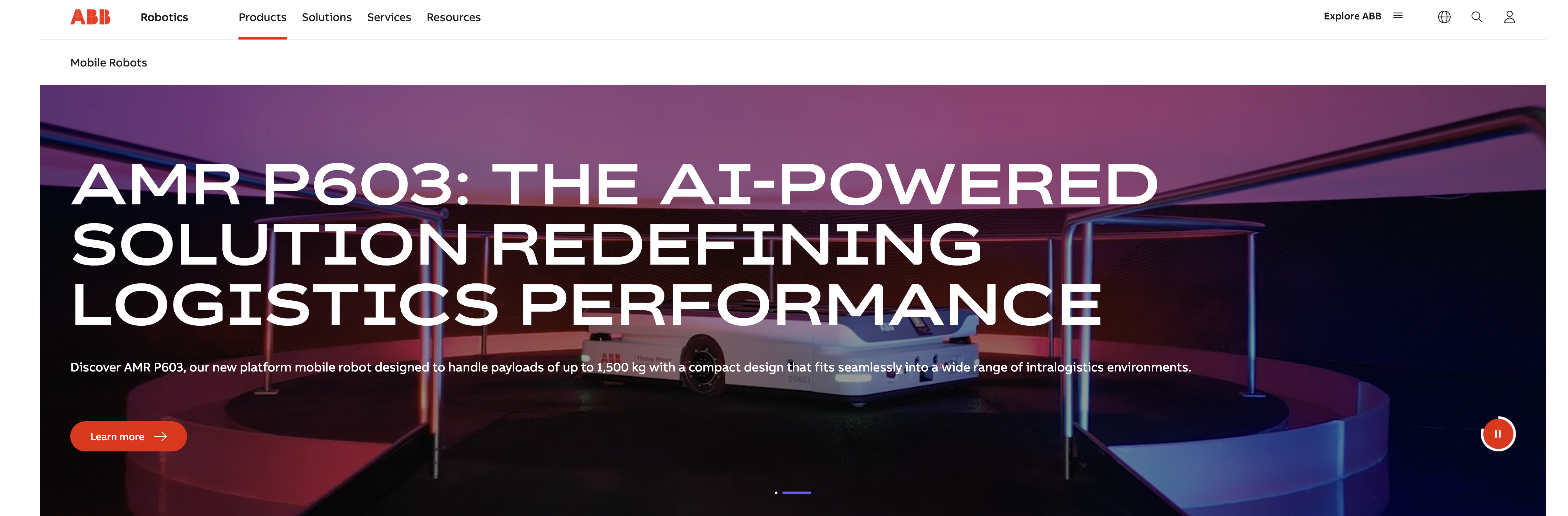
ABB is a front-runner in the field of industrial automation and robotics, with Autonomous Mobile Robots (AMRs) serving as a key component of their solutions. These transport robots are engineered to transport items autonomously within diverse sectors including automotive, logistics, consumer goods, and other industrial environments. Designed and built with the latest software tools and a robust safety architecture, ABB's AMRs can efficiently and safely interact with both people and other machines. These robots are ideal for automating numerous logistics applications in all industrial situations, such as inbound and outbound intralogistics, material handling, line supply and kitting, assembly and sub-assembly lines, end-of-line handling and line feeding, and auxiliary supplies and interprocess connection. Notable features include their ability to adapt in real time to changing workflows and to navigate dynamic spaces without fixed infrastructure. Boosting productivity by automating mundane and repetitive tasks, the ASRs contribute to operational efficiency and cost reduction. They also offer reliability by ensuring timely and traceable deliveries, thus minimizing human errors. In line with ABB's continuous strive towards innovation and building a more efficient and sustainable future, their AMRs integrate forward-looking technologies such as AI, 3D vision, and connectivity solutions.
Pros
- Diverse sector applications
- Efficient machine-human interaction
- Adapts to changing workflows
- Operates without fixed infrastructure
- Boosts productivity
- Operational efficiency and cost reduction
- Ensures timely, traceable deliveries
- Minimizes human errors
- Integrates latest tech advances
- Robust safety architecture
- Flexible for logistics needs
- Ideal for assembly lines
Cons
- Limited to industrial environments
- Requires wide open spaces
- No fixed infrastructure navigation
- Dependent on software tools
- Lack efficiency in tight quarters
- Limited load capabilities
- High initial investment cost
- Potential software compatibility issues
- May require ongoing maintenance
- Possibly long adaptation period